
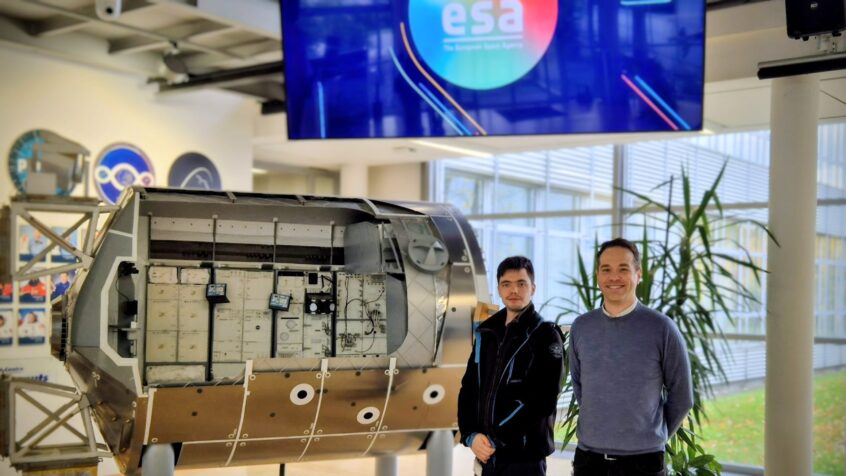
PaleBlue, a leader in digital training technology and simulators, has successfully delivered a zero G simulation engine to ESA, to be used in a number of spacecraft applications, including the Gateway lunar space station program.
This project that was started in 2023 with the goal of developing a Lunar Gateway simulator, has since been expanded to create a flexible simulation platform that can be used with any spacecraft.
This work is based on the established Zero simulation technology that PaleBlue has been working on since 2020, culminating in the release of the 3rd generation of VR astronaut training simulator featuring an array of training scenarios, high definition visuals and advanced physics modeling.
The simulator technology, previously available as a simulation system, has been in the present project modified and extended into a flexible engine that can serve as a foundation for creating new simulators. This allows ESA, along other PaleBlue partners and clients, to build their simulators on top of the PaleBlue simulation engine. The framework allows addressing a wide range of use cases, from spacecraft engineering and design verification, to astronaut training.
With this delivery, PaleBlue expands support to include the two of the most used 3D engines, Unity and Unreal.
PaleBlue platform is continuously used in training at the European Astronaut Centre (EAC), where astronauts such as Marcus Wandt, Slawosz Uznanski and Sophie Adenot, among others, have been trained on the PaleBlue system, prior to their trips to space.

We’re excited to further expand our technology for human spaceflight. With this step, we create an opportunity for others to build simulators using PaleBlue technology. We’re also very pleased to work closely with ESA and their professional XR teams, collaborating to jointly push the boundaries of what’s possible with XR and simulation.Felix Horn, PaleBlue CEO

Zero G simulation in VR is much harder than setting the gravity value to zero, and PaleBlue’s done some very strategic R&D in that field. They’ve explored what VR software can do to allow users to move in zero G with enough realism for training and mission design purposes. Now that the zero G engine is a modular piece of software, we can deploy it beyond training scenarios and expand to any mission design use-case.Martial Costantini, ESA XR Lab Lead

NOSA is happy to see Norwegian companies like PaleBlue getting contracts and deliveries for ESA, showing that Norway can contribute to moving the field of European human spaceflight forward. Astronaut time in space needs to be carefully optimized and improving the training of the astronauts before they go to space ensures that they can make the best use of their time for the maintenance and experiments planned.Øyvind Helleren, NOSA R&D Coordinator
About PaleBlue
PaleBlue is a global leader in training and simulation technology for safety-critical industries, including energy, maritime and space flight. PaleBlue creates interactive training simulations using XR, VR, 3D so trainees can rehearse dangerous scenarios and procedures in a realistic digital environment before performing them in real life. PaleBlue has previously delivered digital training solutions to the energy industry clients, such as Saudi Aramco, Vår Energi (ENI), and Baker Hughes, as well as to the space industry clients, including NASA and the European Space Agency.
About EAC
The European Astronaut Centre (EAC) was established in 1990 and is located near Cologne, Germany. EAC has established itself as a center of excellence for astronaut selection, training, medical support, and surveillance, as well as support of astronauts and their families through preparation for and during flight.
About European Space Agency (ESA)
ESA is Europe’s main organization for space exploration and space technology. ESA’s Space program includes Earth monitoring to track climate change, oceans and natural disasters, Space exploration to other planets and the Moon, Satellite programs launching satellites for Earth observation, navigation and weather monitoring, human spacelift and science missions to study the universe.
About the Norwegian Space Agency
The Norwegian Space Agency (NOSA) is a Norwegian government agency that follows Norway’s public space activities. The agency was established as the Norwegian Space Centre in 1987 in conjunction with Norway’s decision to join the European Space Agency (ESA). It functions as an agency of the Norwegian Ministry of Trade and Industry.
Related Reading
 PaleBlue Delivers ROV Simulator with LARS to OWA in Japan September 22, 2026
  PaleBlue Delivers ROV Simulator to AWI Polar Institute October 2, 2026
  PaleBlue Delivers ROV Training Simulator to OSM Thome May 7, 2024
  PaleBlue Delivers ROV Simulator to the French Navy December 16, 2025
  PaleBlue Delivers IMCA-Accredited ROV Simulator to… August 19, 2026
  PaleBlue Awarded ESA R&D Project on XR July 13, 2026
