
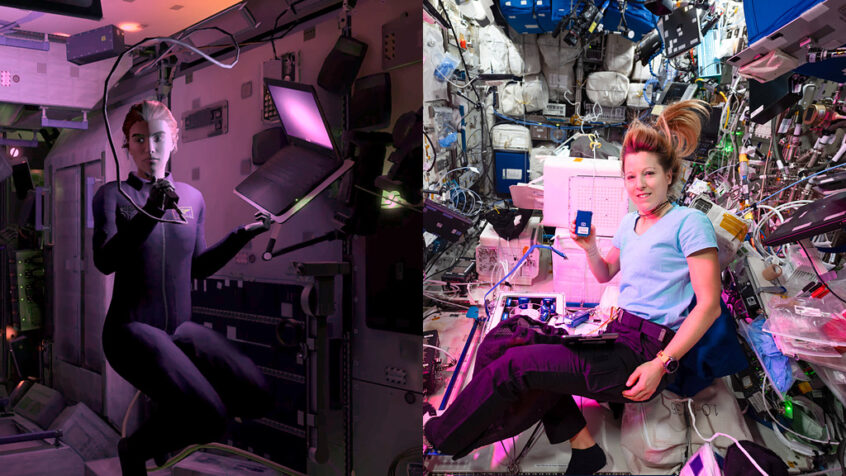
French astronaut Sophie Adenot has successfully completed her Epsilon mission aboard the International Space Station (ISS). PaleBlue is proud to have supported her preparation through our VR astronaut training environments, working in close collaboration with the European Space Agency (ESA) at the European Astronaut Centre (EAC). The successful conclusion of her mission marks another major milestone for the PaleBlue team and its space simulation technology.
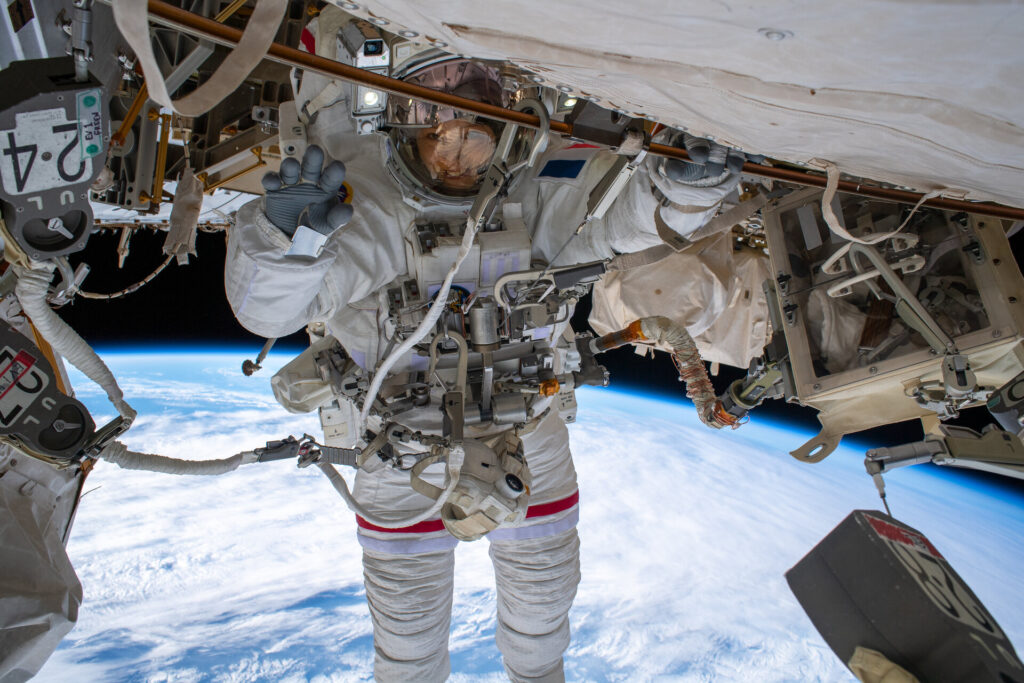
Sophie’s Epsilon mission began in February 2026, when the SpaceX Dragon capsule carrying the Crew-12 astronauts docked with the ISS. Over 237 days in orbit, she carried out numerous scientific experiments, including the GreenBone Ortho experiment, which studies bone regeneration in microgravity to advance healthcare solutions for aging, disease, and injury. Her mission also included French experiments carried out with the French space agency CNES (Centre National d’Études Spatiales), such as the educational ChlorISS experiment, in which students in thousands of classrooms grew seeds alongside her on the ISS. Alongside this research, she logged almost 20 hours in a space suit across three successful spacewalks. Her time on the Station spanned both Expedition 74 and Expedition 75.
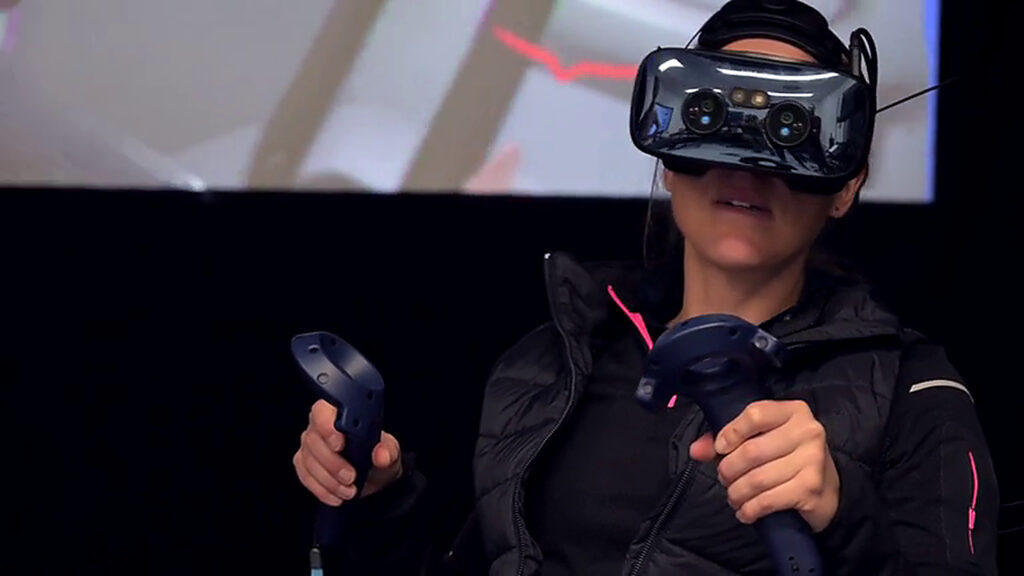
Prior to launch, her mission-specific preparation combined systems and operations training, physical conditioning, neutral buoyancy training for spacewalks and immersive VR sessions at ESA’s XR Lab. As part of this, she used the PaleBlue simulator to familiarize herself with station layouts, zero-gravity navigation and critical mission procedures long before entering orbit. PaleBlue’s human-centric simulation platform provides fully realistic zero-gravity physics, multiplayer capabilities and immersive visual environments.
Sophie Adenot is one of many astronauts who have trained on PaleBlue simulators. The entire ESA astronaut class of 2022 has trained on PaleBlue systems. Astronauts Marcus Wandt and Sławosz Uznański-Wiśniewski also completed PaleBlue training before flying to the ISS on the Axiom-3 and Axiom-4 missions.

We are immensely proud to have supported Sophie Adenot, who served across both ISS Expedition 74 and Expedition 75 with simulation training. By enabling astronauts to practice procedures, explore spatial layouts, and rehearse emergency responses in VR, PaleBlue technology empowers space agencies and commercial space companies to validate designs, rehearse operations, and ensure crews are thoroughly prepared for spaceflight.Felix Horn, CEO at PaleBlue
About PaleBlue
PaleBlue is a global leader in training and simulation technology for safety-critical industries, including energy, maritime and space flight. PaleBlue creates interactive training simulations using XR, VR, 3D so trainees can rehearse dangerous scenarios and procedures in a realistic digital environment before performing them in real life. PaleBlue has previously delivered digital training solutions to the energy industry clients, such as Saudi Aramco, Vår Energi (ENI), and Baker Hughes, as well as to the space industry clients, including NASA and the European Space Agency.
About CNES
The Centre National d’Études Spatiales (CNES) is the French national space agency, established in 1961. It shapes and implements France’s space policy and is one of the main contributors to European space programs. CNES is headquartered in Paris, with its main technical center in Toulouse and operations at the Guiana Space Centre in Kourou, French Guiana. It represents France at the European Space Agency.
About EAC
The European Astronaut Centre (EAC), established in 1990 and located in Cologne, Germany, is home to ESA’s astronaut corps and serves as Europe’s centre of excellence for astronaut selection, training and support. It is the training centre for all European-built ISS hardware, including ESA’s Columbus laboratory, and also trains international partners and private astronauts. Its facilities include Columbus replicas, simulators and a 10-metre-deep Neutral Buoyancy Facility for spacewalk preparation.
About ESA
The European Space Agency (ESA) is committed to peacefully exploring and using space to benefit everyone. Established as an intergovernmental organisation in 1975, it champions European scientific and industrial interests in space. ESA is headquartered in Paris and has around 3,000 staff from its Member States, including scientists, engineers, IT specialists and administrative personnel. Its programs span human and robotic exploration, science, Earth observation, navigation, telecommunications and launchers.
Immersive Space Tech
Explore the capabilities and get a demo of the world's most advanced simulators for zero gravity, spacecrafts and habitats.
Find out moreRelated Reading
 PaleBlue Debuts Its Third Gen VR Astronaut Training May 21, 2025
  PaleBlue Delivers ROV Simulator to the French Navy December 16, 2025
  PaleBlue and Aramco Sign an MoU January 7, 2026
  PaleBlue Awarded ESA R&D Project on XR July 13, 2026
  PaleBlue Life Saving Rules December 7, 2023
  Finansavisen Features PaleBlue's SpaceTech August 14, 2024
